
Natural Feeding for Cats: What It Should Really Mean
Natural feeding for cats should mean more than raw meat. A healthy feline diet must be animal based, moisture rich, complete, balanced and safely prepared, whether it is specialised raw food, a cooked diet or high quality wet food.
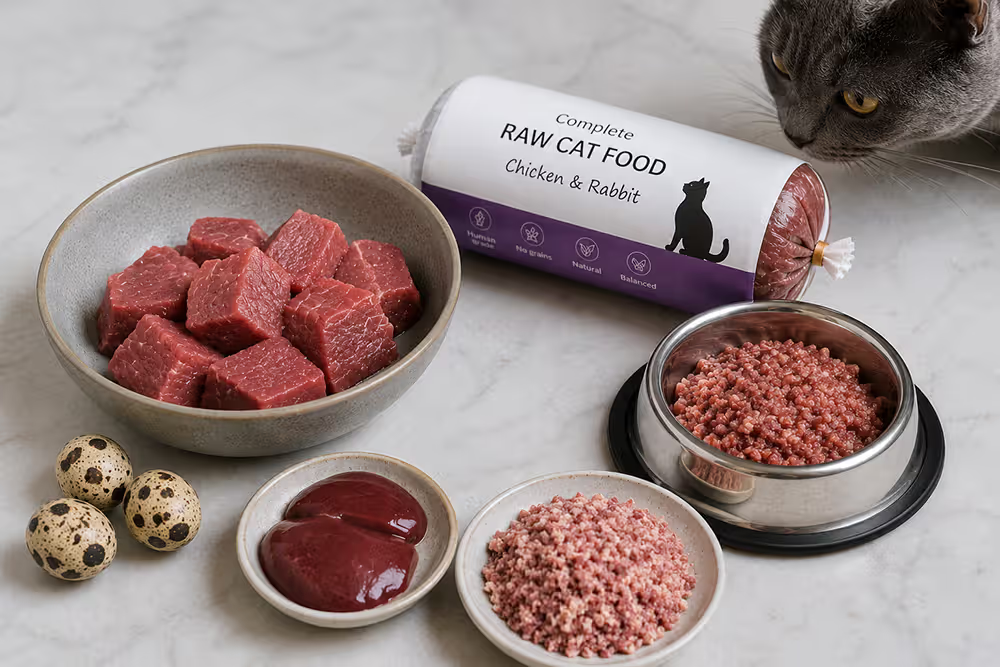
Healthy cats need a healthy diet to maintain good condition, strong muscles, normal digestion and long term vitality.
Kittens need the right diet for growth and development. Pregnant and nursing cats need even more careful nutrition. Older cats need food that helps preserve muscle, energy and organ function. Cats recovering from illness, stress or injury need a diet that supports healing rather than adding unnecessary metabolic burden.
For cats, nutrition is not a secondary detail. It is one of the foundations of health.
But the word “natural” is often used too loosely. Natural feeding does not mean giving a cat random pieces of meat. It does not mean copying internet recipes without understanding balance. It does not mean that every raw product is automatically safe. And it does not mean that every commercial food is bad.
For us, natural feeding means feeding a cat in a way that respects what a cat biologically is: an obligate carnivore. The diet should be based mainly on high quality animal ingredients, contain enough animal protein and fat, provide the correct minerals, vitamins and taurine, and be safe for daily feeding.
The goal is not ideology. The goal is health.
Cats Are Obligate Carnivores
Cats are obligate carnivores. This means that they are not simply animals that “like meat”. They are biologically dependent on nutrients found in animal tissue.
A cat’s body is adapted to use animal protein and animal fat as its main nutritional base. Cats need taurine, arachidonic acid, preformed vitamin A and other nutrients that are naturally present in animal sources. They have a limited ability to use many plant based nutrients in the same way omnivores do.
This is why a healthy feline diet should not be built around grains, starches or plant fillers. Small amounts of plant material or fibre may have a place in some diets, especially for digestion, stool quality or specific veterinary reasons. But they should never replace the animal based foundation of the diet.
A cat is not a small dog. It should not be fed like one.
Natural Does Not Mean Random Meat
One of the most common mistakes in so called natural feeding is the idea that meat alone is enough.
It is not.
Plain muscle meat is not a complete diet for a cat. It contains protein and some important nutrients, but it is not balanced. It is usually too low in calcium, may have an incorrect calcium to phosphorus ratio, and may lack essential vitamins, trace minerals and other nutrients if fed as the main diet.
In nature, a cat does not eat only clean muscle meat. It eats prey. That includes muscle meat, organs, connective tissue, small bones, blood and other animal tissues. This is a very different nutritional package from a chicken breast bought in a shop.
A proper natural diet must therefore be complete and balanced. It must provide the right amount of animal protein, fat, calcium, phosphorus, taurine, vitamins and trace minerals. Without this, even a diet that looks “fresh” or “natural” can damage health over time.
This is especially important for kittens. A growing kitten cannot be safely raised on improvised meat feeding. Mistakes in calcium, phosphorus, vitamin D, taurine or energy intake can affect growth, bones, muscles and general development.
Why Moisture Matters
Cats evolved from ancestors adapted to dry environments. They are not naturally big drinkers. In nature, much of their water intake comes from prey.
This is one of the reasons why moisture in food matters so much.
Dry food is convenient for humans, but it contains very little water. A cat eating mostly dry food must compensate by drinking more, and not all cats do this well. Some cats drink enough, but many do not drink as much as would be ideal.
Wet food, raw food and properly prepared fresh diets contain much more moisture. This supports hydration and can be especially helpful for urinary tract health, kidney support and general metabolism.
This does not mean that every cat eating dry food will become sick. But from a biological point of view, a moisture rich diet is closer to the natural way cats obtain water.
For this reason, we prefer diets that contain a high amount of animal ingredients and natural moisture.
Raw Feeding: Benefits, Risks and Responsibility
Raw feeding can be an excellent choice for cats when it is done correctly. Many cats on a well balanced raw diet have excellent muscle condition, beautiful coat quality, good energy and strong overall appearance. This is not surprising. Cats are obligate carnivores, and a diet based on fresh animal ingredients is much closer to their biological needs than food built mainly around starches and plant fillers.
However, raw feeding does not mean buying raw meat from a supermarket, butcher or farm and giving it to a cat.
Meat sold for human consumption is usually intended to be cooked before eating. It is not produced, balanced or handled as a complete raw diet for cats. It may contain bacteria or parasites that are destroyed during cooking, but remain a risk when the meat is fed raw. Plain muscle meat is also not a complete diet.
If raw feeding is used, it should be a properly formulated raw diet made specifically for cats. This can include BARF style diets or other complete raw cat foods produced by specialised manufacturers. In many parts of Europe, such products are available as deep frozen complete meals. These diets are designed to be balanced and are usually much safer than improvised raw feeding at home.
The important point is simple: raw feeding can be excellent, but only when the food is complete, balanced, fresh, safely produced and intended for cats.
Raw feeding also requires time and discipline. The food must be stored frozen, thawed correctly and served at an appropriate temperature. It should not be given straight from the refrigerator when it is still cold. Once thawed, it should not be repeatedly refrozen. It should also not be thawed or warmed in a microwave.
Microwaving raw food is especially problematic if the food contains ground bone. Even small bone particles can change texture when exposed to heat. They may become harder and less safe, which can increase the risk of injury to the digestive tract. For this reason, raw food should be thawed slowly in the refrigerator and then allowed to reach a safe feeding temperature without cooking it.
Raw feeding is therefore not the easiest way to feed a cat. It can be one of the best options, but only for owners who have access to a high quality complete raw diet and are willing to handle it correctly every day.
For people who do not have the time, storage space or routine for raw feeding, a high quality wet cat food with a high content of animal ingredients is often the more practical choice.
Why Raw Food and Processed Food Should Not Be Mixed
Some owners try to feed raw food together with dry or wet commercial food. We do not consider this a good approach.
When a cat regularly eats raw food, its digestive system works in a mode closer to the digestion of natural animal food. The stomach acid becomes more active because the body needs to digest raw meat, fat, connective tissue and, in some diets, finely ground bone.
If fully processed food is constantly added to this system, especially dry food, it can create unnecessary stress for the stomach and digestion. In some cats, mixed feeding may gradually lead to stomach irritation, unstable digestion, vomiting, diarrhoea or signs of gastritis.
The rule is simple: choose one main feeding system.
Either the cat is fed a properly balanced raw diet produced specifically for cats, or the cat is fed a high quality processed diet, such as good wet food. Constantly mixing raw and processed feeding is a poor compromise.
We do not raise our kittens on raw food as their main diet before they leave for their new homes. We feed them high quality wet food. The reason is practical and important: not every new owner will be able to feed a raw diet correctly.
If a kitten is used only to raw food from early life, its digestion will be adapted to that type of feeding. If the new owners then suddenly change the kitten to processed food, wet food or dry food, this may cause stomach and digestive problems.
If new owners want to transition to raw feeding in their own home, it can be done gradually, calmly and correctly. But the transition should be slow. The main rule remains the same: either a high quality raw diet or a high quality processed diet. Constant mixed feeding is better avoided.
Cooked Natural Diets Can Be a Safer Alternative
Some owners like the idea of natural feeding but are not comfortable with raw food. In that case, a cooked home prepared diet can be a safer alternative.
Cooking reduces many microbiological risks. It can be especially important in homes with young children, elderly people, pregnant women or immunocompromised family members. It may also be more practical for owners who do not want to handle raw meat daily.
But cooked natural feeding has the same basic rule as raw feeding: it must be complete and balanced.
Cooking changes food. Some vitamins are reduced by heat, some nutrients may be lost in cooking water, and the final diet still needs the correct calcium, phosphorus, taurine, trace minerals and vitamins. Taurine is especially important for cats, and heat processing can reduce its level in food. This is one of the reasons why cooked diets usually require a specially designed vitamin and mineral supplement made for this type of feeding.
A cooked natural diet can be good, but it must be properly formulated. It should not be improvised at home from meat and vegetables alone. Ideally, it should be prepared according to a recipe made by a qualified veterinary nutrition specialist, including the correct supplement complex for cooked feline diets.
Natural does not mean guessing. Natural should mean biologically appropriate and nutritionally complete.
High Quality Wet Food Can Also Be a Good Choice
Not every owner has the time, freezer space or routine for raw feeding. Not every cat accepts raw food. Some cats that have eaten commercial food for years refuse to change completely. This can happen, and forcing the issue is not always helpful.
A high quality wet food can be a very good practical choice.
The best wet foods for cats are based on animal ingredients, have a high meat content, provide enough animal protein and fat, contain the required vitamins and minerals, and avoid unnecessary sugar, starch and low quality fillers.
It is especially good when the meat in these foods is gently prepared, for example steamed. Steam cooking can help preserve more natural flavour and nutritional value than aggressive industrial processing. This is one of the reasons why we prefer high quality wet foods where the meat is gently cooked and the composition is clearly stated.
Good wet food has several advantages. It is complete, convenient, moisture rich and easier to feed consistently. It also avoids many of the handling problems of raw food.
This is why we do not present nutrition as a simple choice between “raw is good” and “commercial is bad”. That is too primitive.
The real question is quality.
A poor quality commercial food built around cheap fillers is not the same as a carefully formulated high meat wet food. A random raw meat diet is not the same as a complete raw food made for cats. A homemade cooked diet without balance is not the same as a properly formulated cooked diet.
The label “natural” means nothing if the diet is not suitable for a cat.
How to Read a Cat Food Label
Always read the composition of the food.
If the manufacturer clearly states how much meat is in the food, which animal ingredients are used and in what amounts, this is a good sign. A transparent composition allows you to understand what your cat is actually eating.
If the composition is hidden, if the manufacturer only lists ingredients without exact percentages, uses vague wording or does not show the real amount of meat, it is better not to buy that food.
In high quality raw food from good producers, the composition is usually clearly stated: which meat is used, which organs are included, which supplements are added and how the diet is balanced. This is very different from foods where attractive wording hides an unclear composition.
The same applies to wet and dry food. Beautiful packaging proves nothing. The composition matters.
What to Understand About Dry Food
Dry food is produced using a technology that requires a binding component. Without it, the kibble cannot hold its shape. This component is usually potato, rice, sweet potato, peas, wheat or other plant based ingredients.
This is why dry food almost always contains more carbohydrates and fillers than wet food or raw diets.
We recommend avoiding dry foods where ordinary wheat is the main filler. Modern wheat often contains a high level of gluten, and this is not the best option for cats.
Some dry foods use so called ancestral grains, such as spelt, or other ingredients such as quinoa. This may be a more acceptable option if the overall composition is good and animal ingredients come first.
But it is important to understand that “grain free” does not automatically mean good. If potato or sweet potato is used instead of grain, you still need to know how much of it is in the food. It may be 6 percent or it may be 30 percent. That is a very big difference.
Some cats have individual intolerance to potato, sweet potato, peas or other plant ingredients. In such cases, diarrhoea, soft stool, gas or other signs of poor tolerance may appear.
Dry food must therefore be chosen very carefully. It can be convenient, but biologically it is rarely the best main diet for a cat.
This is why we prefer high quality wet food with a high content of animal ingredients.
What We Avoid in Cat Nutrition
There are some things we do not consider appropriate for cats.
We avoid diets built mainly around grains, starches and plant fillers. Cats do not need food that looks more like cereal than prey.
We avoid added sugar. There is no reason to add sugar to cat food.
We avoid processed human foods such as ham, bacon, sausages and smoked products. These are not suitable foods for cats.
We do not recommend pork in any form. It is fatty and poorly suited to cats, especially Burmese cats. Processed pork products also often contain salt, spices and additives that cats do not need.
Tubular bones must never be given to cats in any form. They are hard, sharp and can damage the stomach or intestines. Bone can be a calcium source only in some professionally formulated raw diets, where it is finely ground and correctly balanced. Owners should not use bones as a home solution for calcium.
We avoid cow’s milk as a regular food. Many adult cats do not digest lactose well. Milk is not necessary for cats. Some fermented dairy products may be tolerated by some cats in very small amounts, but they are not a foundation of feline nutrition.
Onion, garlic, leek and similar ingredients must never be given to cats. They can be toxic to cats.
We avoid random supplements. Vitamins and minerals can be helpful when correctly used, but unnecessary or poorly chosen supplements can create imbalance.
We also avoid the idea that any one feeding style is automatically perfect. Raw, cooked, wet or commercial feeding can all be done well or badly. The details matter.
You can read more about foods that should not be given to Burmese cats in our article “What You Should Not Feed a Burmese Cat”: https://burmese-cats.com/what-you-should-not-feed-a-burmese-cat
Kittens, Seniors and Sick Cats Need Special Care
Not every cat has the same nutritional needs.
Kittens need a diet that supports growth, bone development, muscle formation, immune function and energy demands. Their diet must be complete and precise. This is not the stage of life for experiments.
Pregnant and nursing cats need even more energy and nutrients. Their diet affects not only the mother but also the kittens.
Older cats often need special attention to muscle maintenance, appetite, digestion and organ function. Many older cats lose muscle as they age, and insufficient animal protein can make this worse unless there is a specific medical reason to restrict protein.
Cats with kidney disease, gastrointestinal disease, allergies, pancreatitis, urinary problems or other medical conditions may need individual dietary planning. What is excellent for a healthy cat may not be suitable for a sick cat.
This is why nutrition should always be considered in relation to the individual animal.
Vomiting, diarrhoea, poor coat quality, weight loss, excessive weight gain, bad stool quality or refusal to eat can all be signs that the current diet is not suitable or that a health problem is present.
Freshness, Clean Bowls and Safe Handling Matter
Food quality is not only about ingredients. It is also about freshness and handling.
Cats are sensitive to spoiled food. Raw and wet foods should not be left out for long periods, especially in warm weather. Bowls should be washed thoroughly and regularly.
Ceramic or stainless steel bowls are usually preferable to cheap plastic bowls, which can retain odours, become scratched and harbour bacteria.
Water should always be available. Even cats eating wet food should have access to clean drinking water at all times. Water bowls should also be cleaned regularly.
If raw food is used, hygiene becomes even more important. Hands, surfaces, bowls and utensils must be cleaned carefully. Raw food should be handled with the same seriousness as raw meat in a human kitchen.
Our Practical View at Royal Esprit
At Royal Esprit, we believe that cats should be fed as cats, not as small omnivores.
The foundation of a good feline diet should be animal based, rich in quality animal protein, moisture rich, fresh and suitable for the individual cat.
A complete raw diet made specifically for cats can be excellent when it is safely produced, properly balanced and handled correctly. But it requires time, discipline and access to reliable specialised products.
We use only trusted raw food producers, where the composition is clearly stated and real meat is used, not unclear meat byproducts. But we do not raise our kittens on raw food as their main diet before they leave for their new homes. We use high quality wet food, because it is more practical and safer for most future owners.
The wet foods we prefer are based on animal ingredients, with clearly declared composition, and the meat is gently steamed to help preserve natural flavour and valuable nutrients. This gives kittens a stable, high quality diet that most owners can realistically continue after the kitten moves to a new home.
A properly formulated cooked diet can also be a good option for owners who want natural feeding but prefer to avoid raw food risks.
For many families, high quality wet food with a high content of animal ingredients is the most realistic and reliable everyday solution. This is especially true when the food is complete, balanced and made from good ingredients.
We do not believe in feeding cats cheap food full of unnecessary fillers. We also do not believe in careless raw feeding from supermarket meat.
Good nutrition is not about fashion. It is about understanding what a cat is and feeding accordingly.
A healthy cat needs a diet that respects its nature as an obligate carnivore. That means animal ingredients, enough high quality protein, the right balance of minerals and vitamins, proper moisture, freshness and safe handling.
Natural feeding should never mean careless feeding. Done correctly, it can support excellent condition, strong muscles, beautiful coat and long term vitality. Done incorrectly, it can create serious problems.
The best diet is not the one that sounds most natural in advertising. It is the one that keeps the cat healthy, well developed, active and comfortable in real life.
We give all buyers of our kittens feeding recommendations so that the transition to the new home is calm and safe for the kitten.
Written by Sergej Reiner, felinology specialist at Royal Esprit cattery.
© 2026Royal Esprit. All rights reserved. Reproduction, distribution or republication of this article, in whole or in part, is not permitted without the author’s prior written permission.