
Introduction to Burmese Cat Genetics: Colours, Hidden Genes and DNA Testing
A clear introduction to Burmese cat genetics, explaining how coat colours are inherited, why red and cream cats can have hidden genetic bases, and why DNA testing is essential in responsible Burmese breeding.
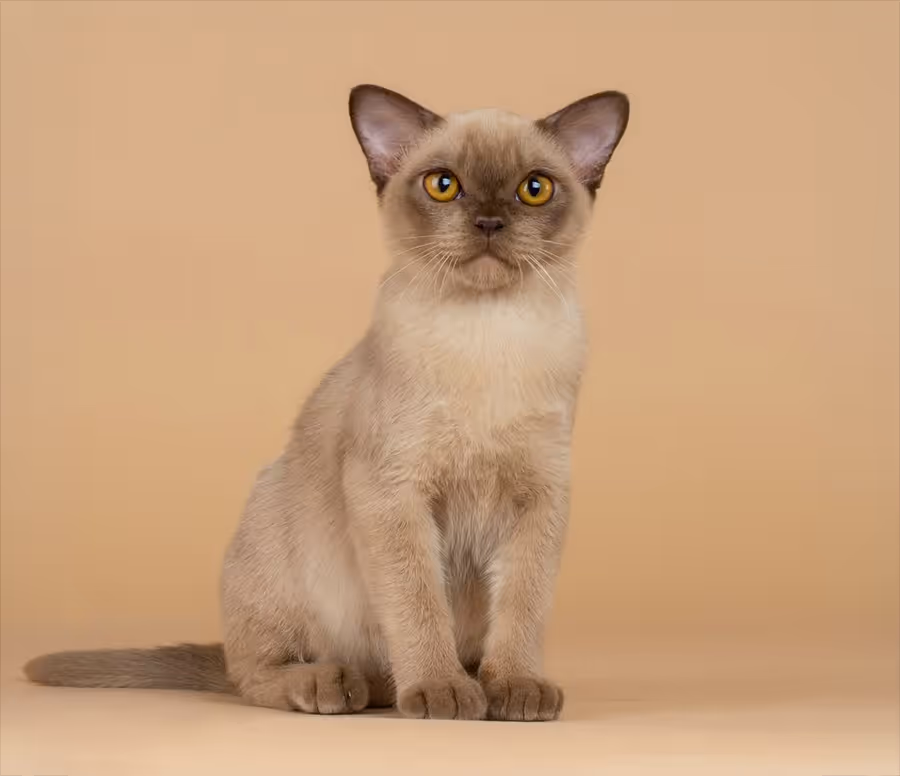
Genetics is one of the foundations of responsible cat breeding. For a future owner, genetics is most often noticed through colour: why one Burmese kitten is born brown, another chocolate, blue, lilac, red or cream. This is a natural interest, because colour is visible immediately and is part of the beauty of the breed.
But for a serious breeder, genetics does not begin with coat colour.
First of all, genetics is necessary for preserving the health of the breed. Some inherited diseases can be passed on by parents that look completely healthy. A cat may show no signs of illness at all, but still carry a genetic variant that becomes dangerous if the wrong breeding pair is chosen. This is why modern breeding cannot be separated from knowledge of inheritance, DNA testing and responsible breeding planning.
Genetics also helps preserve the correct phenotype of the Burmese cat. Phenotype means everything we can see in the animal’s appearance: head type, expression, eye and ear shape, body structure, coat quality, colour and overall balance. A good Burmese cat should not simply be a cat of a beautiful colour. It should preserve health, character and the typical breed features that make the breed recognisable and loved.
Only together with this does genetics also help us understand colour inheritance. Colour is important and interesting, especially in a breed with several beautiful colour varieties. However, colour should never be the only goal of breeding. A rare or attractive colour must never be considered more important than health, correct type and good temperament.
Nevertheless, the easiest place to begin learning genetics is colour. Colours can be seen, compared and easily imagined. Using colour as an example, it is easier to understand the basic principles of inheritance: why a kitten receives genetic information from both parents, how a visible trait can hide other inherited variants, why cats that look the same can produce different offspring, and how genetic knowledge helps breeders make responsible decisions.
For this reason, we will first look at how colours are inherited in Burmese cats. These same principles will then help us understand more serious subjects: inherited diseases, genetic testing, preservation of breed type and responsible planning for future generations.
1. What Is a Gene and Why Does a Kitten Inherit Traits from Both Parents?
To understand cat genetics, we first need to imagine how hereditary information is stored.
The body of a cat can be compared to a huge library of instructions. Inside each cell are chromosomes. They are like large, thick books containing instructions for the development and function of the body. Inside these books are individual sections of information called genes.
Genes are involved in almost everything: body development, organ function, coat formation, appearance and the inheritance of some diseases.
The domestic cat has 38 chromosomes. They form 19 pairs:
- 18 pairs of ordinary chromosomes, called autosomes
- 1 pair of sex chromosomes, which determine the animal’s sex
In a female cat, the sex chromosomes are XX. In a male cat, they are XY.
In each pair, one chromosome comes from the mother and the other from the father. We can imagine that the kitten has 2 copies of each large book: one maternal copy and one paternal copy. Both copies contain instructions for the same general functions of the body, but some entries inside them may differ.
Different versions of the same gene are called alleles.
Why a Kitten Has 2 Copies of Most Genes
When a kitten is formed, the mother and father do not pass on their entire set of chromosomes. Each parent passes on only half.
The mother’s egg cell contains 19 chromosomes:
- 1 chromosome from each of her 18 ordinary chromosome pairs
- 1 sex chromosome, and in a female cat this is always X
The father’s sperm cell also contains 19 chromosomes:
- 1 chromosome from each of his 18 ordinary chromosome pairs
- 1 sex chromosome, either X or Y
When the egg cell and sperm cell join, the kitten again receives a complete set of 38 chromosomes: 19 from the mother and 19 from the father.
This means that for most genes the kitten receives 2 versions:
- one from the mother
- one from the father
Each parent has 2 versions of most genes, but passes only 1 of them to each individual kitten. The same female cat can pass one version of a particular gene to one kitten, and a different version to another kitten. The same is true of the male. This is why kittens in the same litter can differ from each other, even though they have the same parents.
In reality, the variety is even greater, because before genetic information is passed to offspring, paired chromosomes in the parent can exchange sections. As a result, an egg cell or sperm cell can contain a new combination of hereditary information.
For a first understanding, it is enough to remember the main point: each kitten receives half of its genetic information from the mother and half from the father, but the exact combination can be different in every kitten.
Both Copies Are Present, but the Result Can Be Different
It is important to understand that ordinary chromosomes do not work in such a way that one parental copy is switched on while the other is asleep. Both copies exist and take part in the function of the body.
However, the 2 copies of a gene received from the mother and father can be either the same or different.
If a kitten receives the same versions of a gene from both parents, this is called a homozygous state.
If it receives 2 different versions of a gene, this is called a heterozygous state.
These terms sound complicated, but their meaning is simple:
- homozygous means that the 2 inherited copies are the same
- heterozygous means that the 2 inherited copies are different
What happens next depends on the nature of the particular gene versions. In some cases, the difference between them will be visible. In other cases, one version will remain present in the animal’s genetic information and can be passed to offspring, but will not be visible in the animal itself.
What Dominant and Recessive Gene Variants Mean
To show this principle with a simple example, let us mark 2 possible versions of a fictional gene with letters:
- A: dominant variant
- a: recessive variant
This is only a convenient notation. The letters help us see which version the kitten received from each parent.
If a kitten receives the dominant variant from at least 1 parent, the trait linked with that variant will be visible. This means that trait A will appear both in a kitten that received A from both parents and in a kitten that received A from only 1 parent.
A recessive trait appears only when the kitten receives variant a from both parents. If it receives A from one parent and afrom the other, the dominant trait will be visible, but the recessive variant will remain in the animal’s genetic information and can be passed on to offspring.
This can be written as follows:
- AA: the dominant trait is visible, and the recessive variant is absent
- Aa: the dominant trait is visible, but the animal carries the recessive variant
- aa: the recessive trait is expressed
An animal that carries a recessive variant that is not visible is called a carrier of that variant.
Why a Recessive Variant Should Not Simply Be Called “Sleeping”
Sometimes people say, for simplicity, that a recessive gene is “sleeping”. This can help intuitively explain that it is not visible, but it is not completely accurate.
A recessive variant does not disappear and is not switched off as if it were an unused instruction. It remains part of the animal’s hereditary information and can be passed on to offspring.
It is simply that in some cases 1 copy of the dominant variant is enough for the result connected with that variant to be visible.
We can imagine it this way. In 2 copies of the same instruction, slightly different versions are written. If the presence of variant A is already enough to produce a particular result, an animal with the combination Aa will look the same as an animal with the combination AA.
But there is an important difference between them: an animal with Aa can pass the hidden variant a to offspring, while an animal with AA cannot.
A Simple Example of Inheritance
Imagine that a female cat has the combination Aa. Outwardly, she shows the dominant trait A, but she carries the recessive variant a.
The male also has the combination Aa. Outwardly, he also shows the dominant trait A, but he also carries the recessive variant a.
Each parent will pass only 1 of their 2 variants to a kitten. Therefore, the possible combinations are:
- the kitten receives A from the mother and A from the father: AA
- the kitten receives A from the mother and a from the father: Aa
- the kitten receives a from the mother and A from the father: Aa
- the kitten receives a from the mother and a from the father: aa
In the first 3 cases, the kitten will show the dominant trait A.
In the last case, the kitten received the recessive variant from both parents, so trait a will appear.
This is why 2 animals may not visibly show a particular recessive trait, but can still produce a kitten in which that trait appears.
It is also important to understand that possible combinations do not mean a guaranteed number of kittens of each type in every litter. Each kitten receives its own combination separately. This means that even with the same pair of parents, a particular variant may not appear at all in one litter, but may appear in several kittens in another.
Why This Matters in Breeding
This principle is important not only for understanding a cat’s appearance.
Sometimes a hidden recessive variant affects colour. Sometimes it is connected with an inherited disease. An animal may look completely healthy but carry a genetic variant that becomes a problem if the same variant is also passed to a kitten by the other parent.
This is why responsible breeding cannot be based only on what is visible. It must also take into account the animal’s background, known genetic features of its lines and the results of available DNA tests.
Now that the basic principles are clear, we can move to the most visible example: colour inheritance in Burmese cats.
2. Why the Burmese Coat Looks Special
Before we look at why one Burmese cat is born brown, another chocolate, blue or lilac, it is important to understand one special feature of the breed itself.
A Burmese cat is not coloured in the same way as an ordinary solid coloured cat. Even in the classic brown Burmese, the coat should not look like an even, solid black or a uniformly dark colour over the whole body. In a good Burmese cat, the body has a softer, warmer shade, while the face, ears, legs and tail are usually more intensely coloured.
This special appearance is connected with how pigment is produced in the coat.
What Pigment Is
Pigment can be thought of as a natural colouring substance that gives colour to the coat, skin and eyes of an animal.
In cats, 2 types of pigment play the main role:
- dark pigment, which forms black, brown, chocolate and their diluted shades
- red yellow pigment, which is involved in red and cream colours
The presence of pigment alone does not explain exactly what a cat will look like. Different genes can influence which pigment is produced, how strongly it is expressed and how it is distributed over the body.
This is why coat colour cannot be understood as the action of one single “colour gene”. The visible colour of the coat is the result of several genetic mechanisms working together.
The Special Burmese Colour Pattern
The Burmese cat has a special inherited variant that affects not whether the cat will be brown, chocolate, red or another colour, but how intensely that colour will be expressed on the body.
This variant is connected with a gene called TYR. This gene is involved in the production of the enzyme tyrosinase. Tyrosinase is necessary for the body to produce pigment in the coat.
In the Burmese cat, this mechanism works somewhat differently than in a cat with a normal full colour coat. Pigment is produced, but its intensity partly depends on the temperature of the body area.
On warmer areas, especially the body, the colour appears softer and lighter.
On cooler areas, such as the face, ears, legs and tail, pigment is expressed more strongly, so these areas appear darker.
This is what gives the Burmese cat its characteristic appearance: a soft, warm body colour with more intense colour on the extremities, head and tail.
Why Burmese Cats Do Not Look Like Siamese Cats
Some people notice that both Burmese and Siamese cats have darker colour on the face, ears, legs and tail. This is not a coincidence: in both cases the same gene, TYR, is involved, but its inherited variants work differently.
In the Siamese cat, pigment production on the warmer parts of the body is restricted much more strongly. This is why the body remains very light and the darker areas, called points, stand out sharply.
In the Burmese cat, the restriction is much milder. The body is also coloured, and quite richly, but on the cooler areas the colour becomes deeper.
This is why the Burmese cat is not a Siamese cat in a different colour. It has its own genetically determined type of colour expression, characteristic of the Burmese breed.
Burmese Colour and 2 Copies of the Gene
The characteristic Burmese colour expression is also connected with inheriting 2 copies of the corresponding Burmese variant. A purebred Burmese cat receives one such copy from the mother and one from the father.
In genetic notation, the Burmese variant is usually written as cᵇ. Therefore, the characteristic Burmese colour pattern is written as:
cᵇcᵇ
There is no need to memorise this notation at this stage. The important point is this: all recognised colours of the Burmese cat are expressed through the same special Burmese colour mechanism.
A brown Burmese, blue Burmese, chocolate Burmese, lilac Burmese, red Burmese and cream Burmese do not differ because one has the Burmese colour pattern and another does not. The Burmese colour pattern is present in all of them. The difference lies in other genes, which determine which exact colour is modified by this Burmese mechanism.
Why This Matters for Understanding Colours
We can imagine the Burmese genetic mechanism as a special way of expressing colour. It makes the body softer in tone and the cooler parts of the body more intense.
But by itself, it does not yet answer the question of whether the cat will be:
- brown
- chocolate
- blue
- lilac
- red
- cream
- or one of the tortie varieties
These differences are determined by other genes that work together with the Burmese colour pattern.
So we will now look at colour step by step.
3. The Main Dark Colour Group: Why Burmese Cats Can Be Brown or Chocolate
We begin with the main dark colour group. In Burmese cats, this includes 2 colours:
- brown, EMS code BUR n
- chocolate, EMS code BUR b
It is important to avoid a common misunderstanding here. In general cat colour genetics, the basic dark pigmentation is connected with black. But a Burmese cat with this genetic base does not look black, because its colour has already been modified by the Burmese pattern of pigment expression.
For this reason, in Burmese cats the genetic base that would produce black in a cat without the Burmese colour pattern is expressed as the characteristic warm brown. This is the classic Burmese colour and is officially described in FIFe as BUR n: brown.
How Dark Pigment Is Produced
The difference between brown and chocolate is not caused by the same gene that creates the characteristic Burmese way of expressing colour.
As we mentioned earlier, the Burmese colour pattern is connected with the TYR gene. It explains why the body colour is softer and the cooler areas of the body are more intense.
The difference between the brown and chocolate base is connected with another gene, called TYRP1.
This gene is involved in producing the dark pigment called eumelanin. Eumelanin can be imagined as a dark colouring substance from which the deepest dark coat colours are formed.
With the usual version of this gene, full dark pigment is produced. In the Burmese cat, because of the breed’s special colour expression, this dark base does not look black, but brown.
With another version of the TYRP1 gene, dark pigment production is changed. The pigment becomes visually lighter and warmer. In the Burmese cat, this appears as the colour chocolate.
Why Brown in Burmese Should Not Be Called “Genetically Brown”
In everyday language, we see a brown Burmese and naturally call it brown. This is correct when describing the visible coat colour and it agrees with the official terminology of the breed.
But in colour genetics, the variant that produces brown in the Burmese cat is the original dark base. In genetic formulas, it is usually marked with the capital letter B.
The variant that produces chocolate is marked with the lowercase letter b.
So in this article it is important to distinguish between:
- brown as the official visible colour of the Burmese cat
- B as the genetic version that produces the brown base in Burmese
- chocolate as the official visible colour of the Burmese cat
- b as the recessive genetic version that produces the chocolate base when inherited from both parents
This does not mean that a brown Burmese is “really black”. We are describing 2 different things: the visible breed colour and the genetic base from which that colour is formed.
How a Kitten Receives a Brown or Chocolate Base
A kitten receives 2 versions of most genes:
- 1 from the mother
- 1 from the father
This also applies to the gene that determines the brown or chocolate base.
For simplicity, we can mark the possible versions as follows:
- B: the version connected with the brown base
- b: the version connected with the chocolate base
The B version is dominant over b. This means that for the brown base to appear, it is enough for the kitten to receive Bfrom at least 1 parent.
Chocolate appears only when the kitten receives b from both the mother and the father.
This gives 3 possible combinations:
- BB: the cat will be brown and cannot pass on chocolate
- Bb: the cat will be brown, but can pass chocolate to its kittens
- bb: the cat will be chocolate
This is a very important principle: 2 Burmese cats with the same visible brown colour can be genetically different.
One brown cat may have the combination BB. It looks brown and can pass only the brown base.
Another brown cat may have the combination Bb. It also looks brown, but carries the hidden chocolate variant and can pass it to its kittens.
These 2 cats may not necessarily look different. The difference becomes important when planning offspring.
What “Brown Carrying Chocolate” Means
When we say that a brown Burmese cat carries chocolate, this does not mean that chocolate shades will be visible in its coat.
It means only one thing: its genetic information contains 1 copy of the b variant.
The cat looks brown because the dominant B version is present together with b.
But when eggs or sperm are formed, such a cat can pass on to a kitten:
- either B
- or b
If the other parent also passes b, the kitten will receive the combination bb and will be chocolate.
This is how a hidden recessive variant can appear in the next generation.
Example: 2 Brown Parents Can Produce a Chocolate Kitten
Imagine that both the male and the female look brown.
If both have the genetic combination BB, chocolate kittens cannot be born from this pair, because neither parent carries the b variant.
If one parent has BB and the other has Bb, the kittens can be brown, and some may inherit the hidden chocolate variant. But a chocolate kitten still cannot be born, because only 1 parent can pass b.
But if both brown parents carry chocolate, meaning that both have the combination Bb, each of them can pass either B or b to a kitten.
For each individual kitten, the possible results are:
- BB: brown, not carrying chocolate
- Bb: brown, carrying chocolate
- bb: chocolate
In such a mating, chocolate kittens are possible, even though both parents are visibly brown.
Example: What a Chocolate Cat Passes On
A chocolate Burmese cat has the combination bb.
This means that it has no B version to pass on. Every kitten born from a chocolate parent will receive the b variant from that parent.
But whether the kitten itself will be chocolate depends on the other parent.
If the other parent passes B, the kitten will be brown, but will definitely carry chocolate.
If the other parent passes b, the kitten will be chocolate.
For example:
- chocolate female bb and brown male BB will produce only brown kittens, but all of them will carry chocolate
- chocolate female bb and brown male carrier Bb can produce both brown carrier kittens and chocolate kittens
- chocolate female bb and chocolate male bb will produce only chocolate kittens
Why This Matters for Breeders
For a future owner, the difference between brown and chocolate is mainly visible in the beauty and shade of the kitten’s coat.
For a breeder, it is also a question of inheritance. The breeder needs to understand which variants an animal can pass on and which colours are possible from a particular pair.
At the same time, the chocolate colour is not better or worse than brown. It is simply a different inherited colour variant. In responsible breeding, a pair should never be chosen only for the purpose of producing a particular colour. Health, temperament, breed type and genetic compatibility of the parents are always more important than the colour of future kittens.
4. Dilution: Why Brown Becomes Blue and Chocolate Becomes Lilac
We have already looked at 2 main dark colours in Burmese cats:
- brown appears on the main dark genetic base
- chocolate appears when the kitten receives the recessive chocolate variant from both parents
But Burmese cats also have 2 other colours that are closely connected with brown and chocolate:
- blue, EMS code BUR a
- lilac, EMS code BUR c
Blue and lilac do not come from a completely separate colour group. They appear when an existing colour base becomes visually lighter because of another inherited mechanism.
This mechanism is called dilution, meaning genetic dilution of colour.
What Happens During Dilution
For the coat to appear as a particular colour, pigment must not only be produced, but also correctly distributed inside the hair shaft.
In a cat with a full colour coat, pigment granules are distributed in the hair in a way that makes the colour look richer and deeper.
With dilution, the pigment does not disappear and does not turn into a different pigment. Its distribution inside the hair changes: the pigment granules are arranged less evenly, and this makes the coat look visually lighter and softer in tone.
This is why genetically diluted brown in a Burmese cat appears as blue, while genetically diluted chocolate appears as lilac.
This mechanism is connected with the MLPH gene, which is involved in the correct movement and distribution of pigment granules inside the hair. In domestic cats, dilution is inherited as a recessive trait: for dilution to be visible, the kitten must receive the relevant gene variant from both parents.
Why Blue Is Connected with Brown
A brown Burmese cat has the main dark colour base, which we marked as B.
If this base appears without genetic dilution, the cat will be brown.
If the same base is combined with dilution, the colour becomes lighter and appears as blue.
In other words:
- brown base without dilution: brown, BUR n
- brown base with dilution: blue, BUR a
Blue does not mean that the cat has a new base unrelated to brown. It is the diluted expression of the same main dark colour group.
Why Lilac Is Connected with Chocolate
A chocolate Burmese cat has the recessive chocolate base, which we marked as bb.
If this base appears without genetic dilution, the cat will be chocolate.
If the chocolate base is combined with dilution, the colour becomes much lighter and appears as lilac.
In other words:
- chocolate base without dilution: chocolate, BUR b
- chocolate base with dilution: lilac, BUR c
This means that a lilac cat is always genetically connected with 2 factors:
- it has the chocolate base
- it shows dilution
How Dilution Is Inherited
As with the brown and chocolate base, the kitten receives 2 versions of the gene connected with dilution:
- 1 from the mother
- 1 from the father
The following notation is used for this mechanism:
- D: the full colour version, where dilution is not expressed
- d: the recessive dilution variant
The D variant is dominant over d. This means that visible dilution appears only when the kitten receives d from both parents.
This gives 3 possible combinations:
- DD: the coat is not diluted, and the cat does not carry dilution
- Dd: the coat is not diluted, but the cat carries dilution
- dd: the coat is diluted, and dilution is visible
It is especially important to use the correct terms here.
A brown cat with the combination Dd is not blue. It remains brown, but can pass dilution to its kittens.
A chocolate cat with the combination Dd is not lilac. It remains chocolate, but can also pass dilution to its kittens.
A blue or lilac colour will appear only in a kitten with the combination dd, meaning that the kitten received the recessive dilution variant from both the mother and the father.
How Colour Base and Dilution Work Together
Now we can combine the 2 mechanisms we have already learned:
- brown or chocolate base
- absence or expression of dilution
Together they produce the 4 main non red colours of Burmese cats:
- B_ D_: brown
- B_ dd: blue
- bb D_: chocolate
- bb dd: lilac
The underscore means that the second version in that place can be either variant, because it no longer changes the visible result.
For example:
- BB DD, BB Dd, Bb DD and Bb Dd will look brown
- BB dd and Bb dd will look blue
- bb DD and bb Dd will look chocolate
- bb dd will look lilac
The meaning of this notation is simple:
- for chocolate, 2 chocolate variants are needed: bb
- for a diluted colour, 2 dilution variants are needed: dd
- if the cat has a brown base and dilution is expressed, the result is blue
- if the cat has a chocolate base and dilution is expressed, the result is lilac
What “Brown Carrying Dilution” Means
A brown Burmese cat can look richly brown and still carry the recessive dilution variant.
This means that it has the combination Dd. Dilution is not visible, because 1 copy of D is enough for the coat to remain full colour.
But such a cat can pass on to its kittens:
- either D
- or d
If the other parent also passes d, the kitten will receive dd, and its colour will be diluted.
It is important to say “carries dilution”, not “carries blue”. Blue is already a visible colour, which appears only when dilution is expressed on a brown base.
What “Chocolate Carrying Dilution” Means
The same logic applies to a chocolate cat.
A chocolate cat with the combination bb Dd will look chocolate, not lilac. But it carries dilution and can pass the dvariant to its offspring.
If a kitten receives the chocolate base from both parents and also receives dilution from both parents, it will be lilac.
Example: 2 Brown Parents Can Produce a Blue Kitten
Imagine that both the male and the female are brown, but both carry dilution.
For dilution, their genetic notation is:
- mother: Dd
- father: Dd
Outwardly, both remain brown, because each has the full colour variant D.
But each of them can pass the d variant to a kitten.
For each individual kitten, the possible combinations for dilution are:
- DD: dilution will not appear, and the kitten will not carry dilution
- Dd: dilution will not appear, but the kitten will carry dilution
- dd: dilution will appear
If a kitten with dd has a brown base, it will be blue.
This means that 2 visibly brown parents can produce a blue kitten if both carry dilution.
Example: How a Lilac Kitten Can Be Born
For a lilac kitten to be born, 2 conditions must come together:
- the kitten must receive the chocolate base from both parents, meaning it must have bb
- the kitten must receive dilution from both parents, meaning it must have dd
Only these 2 conditions together produce:
bb dd: lilac
For example, if 2 brown parents both carry chocolate and dilution, they can produce a kitten of any of the 4 colours we are discussing:
- brown
- blue
- chocolate
- lilac
The parents may both look brown. But each can pass on a hidden chocolate variant and a hidden dilution variant. In an individual kitten, these recessive variants can come together and become visible.
What Blue and Lilac Cats Pass On
A blue cat has visible dilution, so its notation for this gene is always dd.
This means that it must pass the d variant to every kitten.
But this does not mean that all its kittens will be blue. For the kitten’s colour to be diluted, it must also receive a second dfrom the other parent.
A lilac cat also has the combination dd, so it must pass dilution to every kitten.
In addition, a lilac cat has the chocolate base bb. This means that it must pass to every kitten:
- 1 chocolate variant b
- 1 dilution variant d
The visible colour of the kitten depends on what it receives from the other parent.
Example: Lilac and Brown
Imagine that a lilac female is paired with a brown male who carries neither chocolate nor dilution.
The lilac female can pass only:
- b for the colour base
- d for dilution
The brown male, who carries no hidden variants, will pass:
- B for the colour base
- D for dilution
All kittens from this mating will receive:
Bb Dd
Outwardly, all of them will be brown, because they received the dominant brown base and the full colour variant.
But all of them will carry:
- chocolate
- dilution
This example clearly shows the difference between visible appearance and genetic information. A lilac mother and a brown father can produce only brown kittens, but these brown kittens will be genetically different from brown kittens that do not carry hidden recessive variants.
5. The Red Factor: Why Red Is Inherited Differently from Brown, Chocolate, Blue and Lilac
In the previous sections, we looked at 2 mechanisms that create the 4 main Burmese colours:
- the brown or chocolate base
- absence or expression of genetic dilution, which turns brown into blue and chocolate into lilac
Both of these mechanisms are inherited through ordinary chromosomes. A kitten receives the relevant gene variants from both the mother and the father, regardless of whether the kitten is male or female.
With red and cream, the situation is different.
The red factor is located on the X chromosome. It is the X chromosome that determines whether a kitten receives the red factor or not. And because the X chromosome is also involved in determining sex, the inheritance of red works differently in males and females.
In the official FIFe system, red and cream Burmese colours are written as:
- red, EMS code BUR d
- cream, EMS code BUR e
Red and cream are connected with the same red factor. The difference between them is that cream is the genetically diluted form of red.
What Determines the Sex of a Kitten
A female cat has 2 X chromosomes:
XX
A male cat has 1 X chromosome and 1 Y chromosome:
XY
Each kitten receives 1 sex chromosome from the mother and 1 from the father.
The mother has only X chromosomes, so she always passes an X to the kitten.
The father has X and Y chromosomes, so he can pass:
- X, and the kitten will be female: XX
- Y, and the kitten will be male: XY
In other words, the kitten’s sex is determined by which sex chromosome it receives from the father.
Where the Red Factor Is Located
The red factor is located on the X chromosome. It is the X chromosome that determines whether a kitten receives the red factor or not.
In classic genetic notation, it is written as follows:
- O: the X chromosome carries the red factor
- o: the X chromosome does not carry the red factor
The letter O comes from the word orange. In cat genetics, this term is traditionally used for the mechanism that appears in Burmese cats as the official colour red, or, when genetic dilution is present, as cream.
It is important to distinguish between 2 things:
- the presence of the red factor is determined by the X chromosome
- whether this red colour appears as red or as its diluted form cream depends on the separate dilution mechanism
For a long time, the exact molecular cause of red colour in cats was unknown, although its inheritance through the X chromosome was well understood. In 2025, it was established that red colour in domestic cats is connected with a change in the region of the ARHGAP36 gene on the X chromosome.
For practical understanding of inheritance, the traditional symbols O and o remain useful.
What the Red Factor Does
If the X chromosome carries the red factor, red yellow pigment is formed in the coat instead of the visible expression of the dark base. This is why a cat looks red, or cream if genetic dilution is also present.
It is very important to understand that the red factor hides the visible expression of the brown or chocolate base, but it does not remove that base from the animal’s genotype.
A red male or red female still has a brown or chocolate base and can pass it to offspring. But while the red factor is expressed in the animal itself, that base is not directly visible in its coat colour.
If a kitten does not receive the red factor, its base is no longer hidden: it will appear visibly as brown, chocolate, blue or lilac, depending on the combination of genes received.
Why a Red Male Needs Only 1 Red Variant
A male has only 1 X chromosome:
XY
He always receives this X chromosome from his mother. From his father, he receives a Y chromosome, which makes him male.
Therefore, for the red factor a male has only 2 main possibilities:
- his X chromosome carries O, and he will be red, or cream if dilution is expressed
- his X chromosome carries o, and he will not be red or cream. His visible colour will be determined by the ordinary colour base and possible dilution: brown, chocolate, blue or lilac
A male cannot simply carry the red factor while remaining visibly brown, chocolate, blue or lilac. If his only X chromosome carries the red factor, that factor will be expressed in his coat colour.
This is one reason why red males are more common than fully red females: a male needs to receive the red factor only on his single X chromosome.
From Whom a Red Male Receives the Red Factor
Since a male receives his X chromosome only from his mother, he can receive the red factor only from her.
A red male cannot receive the red factor from his father, because the father passes a Y chromosome, not an X, to his sons.
If a male red kitten is born, his X chromosome with the red factor must have come from his mother.
At the same time, the father still contributes to the kitten’s colour. He passes to his son the genetic variant for the brownor chocolate base, and also the gene variant connected with dilution. But the father does not pass the red factor to his son.
Why Red Inheritance Is More Complex in Females
A female cat has 2 X chromosomes:
XX
She receives one X chromosome from her mother and one from her father. This means that she has 3 main possibilities for the red factor:
- neither X chromosome carries the red factor
- both X chromosomes carry the red factor
- only 1 of the 2 X chromosomes carries the red factor
This can be written as:
- oo: no red factor
- OO: the red factor is present on both X chromosomes
- Oo: the red factor is present on only 1 of the 2 X chromosomes
If a female has oo, she will not be red, cream or tortie. Her visible colour will be determined by the brown or chocolatebase and by the presence or absence of dilution.
If a female has OO, she will be red, or cream if dilution is expressed.
If a female has Oo, she will be tortie. We will look at why this happens in the next section.
What a Red Female Passes to Her Kittens
A red female has the red factor on both X chromosomes: OO.
This means that she will pass an X chromosome with the red factor to every kitten.
For sons, this is especially simple:
- a son receives his X chromosome from his mother
- a red mother always passes an X with the red factor
- therefore all sons of a red female will be red, or cream if dilution is expressed
For daughters, the result also depends on the father:
- the daughter receives an X with the red factor from her red mother
- she receives her second X chromosome from her father
- if the father also passes an X with the red factor, the daughter will be red or cream
- if the father passes an X without the red factor, the daughter will be tortie
What a Red Male Passes to His Kittens
A red male has only 1 X chromosome, and it carries the red factor.
He passes a Y chromosome to his sons. Therefore, sons of a red male do not receive the red factor from him. Whether they are red or cream depends entirely on the X chromosome received from the mother.
A red male passes his only X chromosome to his daughters. Since this X chromosome carries the red factor, all daughters of a red male receive the red factor from him.
But this does not yet mean that all daughters will be fully red. The result depends on which X chromosome they receive from the mother:
- if the mother passes an X without the red factor, the daughter will be tortie
- if the mother passes an X with the red factor, the daughter will be red or cream
This is the main difference from inheritance of brown, chocolate or dilution. A male passes ordinary colour genes to both sons and daughters. A red male passes the red factor only to daughters, because only daughters receive his X chromosome.
The Important Difference Between the Red Factor and the Colour Base
It is easy to make a wrong conclusion here: if the son of a red male does not receive the red factor from his father, then the father does not influence his colour.
That is not correct.
The son of a red male does not receive the red factor from his father, because he receives the Y chromosome from his father, and the red factor is located on the X chromosome.
But at the same time, the father passes ordinary genes to his son, including genes responsible for:
- the brown or chocolate base
- presence or absence of inherited dilution
If the son receives the red factor from his mother, the brown or chocolate base received from both parents will be hidden under red or cream.
If the son does not receive the red factor from his mother, this base will appear visibly as brown, chocolate, blue or lilac.
So the X chromosome determines whether the kitten has the red factor. But the colour base and dilution continue to be inherited separately from both parents.
A Simple Example: Red Male and Brown Female
Imagine this mating:
- the father is red
- the mother is brown, which means she does not have the red factor
All daughters receive:
- an X chromosome with the red factor from the red father
- an X chromosome without the red factor from the brown mother
Therefore, all daughters from this mating will be tortie. Which exact tortie colour appears will depend on their brown or chocolate base and on whether dilution is present.
Sons receive:
- a Y chromosome from the red father
- an X chromosome without the red factor from the brown mother
Therefore, sons from this mating will not be red or cream. Their colour base will not be hidden by the red factor and will appear as brown, chocolate, blue or lilac, depending on the other genes received from both parents.
At the same time, the sons still receive from the red father his genetic variant for the brown or chocolate base and his variant of the gene connected with dilution.
6. Tortie Colours: Why One Female Cat Can Show 2 Colours at the Same Time
In the previous section, we explained that the red factor is located on the X chromosome.
A male has only 1 X chromosome. This means that he usually either receives the red factor and becomes red or cream, or he does not receive it, and then his colour appears as brown, chocolate, blue or lilac.
In a female, the situation is different. She has 2 X chromosomes: one from her mother and one from her father.
If both of her X chromosomes carry the red factor, she will be red or cream.
If neither of her X chromosomes carries the red factor, she will be brown, chocolate, blue or lilac.
But if only 1 of her 2 X chromosomes carries the red factor, a special colour appears. This is called tortie, or tortoiseshell.
In the English version of the FIFe standard, the recognised Burmese tortie colours are:
- seal tortie, EMS code BUR f
- blue tortie, EMS code BUR g
- chocolate tortie, EMS code BUR h
- lilac tortie, EMS code BUR j
There is one peculiarity in the official terminology: the main dark Burmese colour is called brown, but the corresponding tortie colour is called seal tortie in the English FIFe standard. For this reason, in this article we use the official term seal tortie, although the non red areas of this colour correspond to the Burmese brown colour.
Why a Tortie Female Shows 2 Colours
A tortie female has 2 different X chromosomes with regard to the red factor:
- one X chromosome carries the red factor O
- the other X chromosome does not carry the red factor o
This can be written as:
Oo
But why does such a cat not become simply red or simply brown? Why does she have areas of different colours?
The reason is connected with a special mechanism that exists in female mammals, including cats.
A female has 2 X chromosomes, but the cell does not need all genes on both X chromosomes to work at double strength. Therefore, very early in embryonic development, in each cell, 1 of the 2 X chromosomes is largely switched off.
This process is called X chromosome inactivation.
It is important to understand that this does not apply to the 18 pairs of ordinary chromosomes we discussed earlier. Ordinary chromosomes do not work according to the principle that one is active and the other is switched off. X inactivation is a special mechanism for the 2 X chromosomes in a female cat.
How Red and Base Colour Areas Are Formed
In a tortie female, one X chromosome carries the red factor, and the other does not.
At an early stage of development, in one group of cells the active X chromosome is the one with the red factor. In the coat that grows from these cells, red will appear, or cream if the cat received dilution from both parents.
In another group of cells, the active X chromosome is the one without the red factor. Since the active X chromosomedoes not carry the red factor, red colour does not appear in that area. Instead, the cat’s main colour, determined by other genes, becomes visible: brown or chocolate, or blue or lilac if the cat received dilution from both parents.
After one of the 2 X chromosomes remains active in a particular early cell, that cell continues to divide. New cells formed from its divisions keep the same choice of active X chromosome. This is why a tortie cat does not simply have isolated random hairs of different colours, but groups of hairs and coat areas of different colours.
So in one cat we can see:
- areas of red and areas of brown in seal tortie
- areas of cream and areas of blue in blue tortie
- areas of red and areas of chocolate in chocolate tortie
- areas of cream and areas of lilac in lilac tortie
This combination creates the tortie colour.
Why Every Tortie Pattern Is Unique
It is impossible to predict in advance which X chromosome will remain active in each early embryonic cell.
In one group of cells, the active X will be the one with the red factor. In another group of cells, the active X will be the one without the red factor.
As the body develops, these groups of cells form areas of skin and coat. This is why one tortie female may have larger, more visible colour patches, while another may have the colours more finely mixed.
Even 2 tortie sisters from the same parents will not have exactly the same distribution of colours. Their genetic base may be similar, but the exact coat pattern is formed individually during early development.
What Determines the Exact Tortie Colour
The red factor explains why areas of red colour appear. But it does not determine which colour will be visible in the areas where the red factor is not expressed.
That depends on the mechanisms we already know:
- whether the cat has a brown or chocolate base
- whether the cat received dilution from both parents
This gives the 4 main Burmese tortie colours.
Seal Tortie
In a seal tortie female, red areas are combined with brown areas.
This means:
- 1 X chromosome carries the red factor
- the other X chromosome does not carry the red factor
- the non red colour base appears as brown
- dilution is not expressed
In the English FIFe standard, this colour is written as:
BUR f: seal tortie
Blue Tortie
In a blue tortie female, cream areas are combined with blue areas.
Why not red with blue? Because dilution affects both visible colour components at the same time:
- the brown base becomes blue with dilution
- red becomes cream with dilution
This means that the diluted form of seal tortie is not blue with red, but blue tortie, where blue areas are combined with cream areas.
In FIFe, this colour is written as:
BUR g: blue tortie
Chocolate Tortie
In a chocolate tortie female, red areas are combined with chocolate areas.
This means:
- the cat has the red factor on only 1 of her 2 X chromosomes
- her non red colour base is chocolate
- dilution is not expressed
In FIFe, this colour is written as:
BUR h: chocolate tortie
Lilac Tortie
In a lilac tortie female, cream areas are combined with lilac areas.
This is the diluted form of chocolate tortie:
- the chocolate base becomes lilac with dilution
- red becomes cream with dilution
In FIFe, this colour is written as:
BUR j: lilac tortie
Why a Tortie Female Can Pass Different Variants to Her Kittens
A tortie female has 2 different X chromosomes with regard to the red factor:
- one with the red factor
- one without it
When she passes genetic information to a kitten, she passes only 1 of her 2 X chromosomes.
Therefore, from the same tortie mother, one kitten may receive an X with the red factor, while another kitten may receive an X without the red factor.
For sons, this means:
- a son who receives an X with the red factor from his tortie mother will be red, or cream if he also receives dilution from both parents
- a son who receives an X without the red factor from her will be brown or chocolate, or blue or lilac if he also receives dilution from both parents
For daughters, the result also depends on the X chromosome received from the father:
- if a daughter receives the red factor from only 1 parent, she will be tortie
- if a daughter receives the red factor from both parents, she will be red, or cream if she also receives dilution from both parents
- if a daughter receives the red factor from neither parent, she will be brown or chocolate, or blue or lilac if she also receives dilution from both parents
At the same time, the brown or chocolate base and dilution, as before, are inherited separately from the red factor and are passed to kittens by both parents.
Example: Tortie Female and Brown Male
Imagine this mating:
- the mother is seal tortie
- the father is brown, which means he does not have the red factor
The mother can pass to a kitten:
- an X chromosome with the red factor
- or an X chromosome without the red factor
The father passes:
- a Y chromosome to his sons
- an X chromosome without the red factor to his daughters
For the red factor, the possible results are:
- sons who receive an X with the red factor from the mother will be red; if they also receive dilution from both parents, they will be cream
- sons who receive an X without the red factor from the mother will not be red or cream
- daughters who receive an X with the red factor from the mother will be tortie
- daughters who receive an X without the red factor from the mother will not be tortie, red or cream
The exact non red or tortie colour of the kitten will depend on its brown or chocolate base and on whether it received dilution from both parents.
Why Tortie Cats Are Almost Always Female
For a typical tortie colour, 2 different X chromosomes are needed:
- one with the red factor
- one without the red factor
A normal female has 2 X chromosomes, so this combination is possible.
A normal male has only 1 X chromosome and 1 Y chromosome. This means that he usually cannot have both an X with the red factor and an X without the red factor at the same time. He will either be red or cream, or he will show his non red colour base.
This is why tortie females are common, while tortie males are very rare exceptions.
Can Tortie Males Exist?
Yes, very rarely, tortie males can be born.
Such a colour in a male is not explained by the usual XY pattern, because in the normal male sex chromosome set he has only 1 X chromosome.
One possible reason is that the male has an additional X chromosome, meaning a sex chromosome set of XXY. If one of his X chromosomes carries the red factor and the other does not, he can develop a tortie colour. Such males are usually infertile.
However, this is not the only possible explanation. In rare cases, a tortie male may result from mosaicism or chimerism, where genetically different cell populations are present in the body. In some such cases, the male may remain fertile.
Therefore, the correct statement is this: tortie males are extremely rare, and their appearance is connected with unusual genetic mechanisms. Many of them are infertile, but infertility is not absolutely required in every case.
7. The Hidden Colour Base of Red and Cream: Why Cats That Look the Same Can Be Genetically Different
Now we can connect all the mechanisms we have already discussed.
In the Burmese cat, the main colour group is determined by whether the cat has a brown or chocolate base. A separate dilution mechanism determines whether this base remains full colour or becomes diluted: brown becomes blue, and chocolate becomes lilac.
The red factor is inherited separately. It is located on the X chromosome and determines whether the ordinary colour base will be visible in the coat or hidden under red or cream.
This is why a red or cream Burmese cat has not only the visible red or cream colour. Under that visible colour there is always a base inherited from both parents.
What the Hidden Base Means
If a cat has not received the red factor, its colour base is directly visible:
- brown base without dilution appears as brown
- chocolate base without dilution appears as chocolate
- brown base with dilution appears as blue
- chocolate base with dilution appears as lilac
But if the red factor is expressed in a male or female, the same base is no longer directly visible in the coat:
- without dilution, the animal looks red
- with dilution inherited from both parents, the animal looks cream
However, the genes for the brown or chocolate base do not disappear. They remain in the animal’s genotype and can be passed to kittens.
This is why under a red coat there may be:
- a brown base
- a chocolate base
And under a cream coat there may be:
- a diluted brown base, meaning blue based
- a diluted chocolate base, meaning lilac based
Why Red Can Be Brown Based or Chocolate Based
A red female or red male does not visibly show brown or chocolate, because the red factor hides its expression.
But for the gene that determines the brown or chocolate base, the animal still receives 2 versions:
- 1 from the mother
- 1 from the father
As we have already discussed:
- BB means a brown base without the chocolate variant
- Bb means a brown base carrying chocolate
- bb means a chocolate base
If a red female or male has the combination BB or Bb, the hidden base is brown. In the calculator, this colour is written as:
Red, brown based
If a red female or male has the combination bb, the hidden base is chocolate. In the calculator, this colour is written as:
Red, chocolate based
Both animals will look red. The difference is not in the visible colour, but in which base variants they can pass to their kittens.
Red, Brown Based Does Not Always Mean the Same Genotype
Even within the category Red, brown based, there can be 2 different genetic situations.
A red animal with the combination BB has a brown base and cannot pass chocolate.
A red animal with the combination Bb also has a brown base, because brown is dominant over chocolate. But this animal carries chocolate and can pass it to offspring.
This means that 2 red males may both correctly be called Red, brown based, but one will pass only the brown base, while the other can also pass chocolate.
For a general colour calculation, it is enough to know whether the hidden base is brown or chocolate. For a more precise breeding calculation, it is also important to know whether a brown based animal carries chocolate.
When a Red Animal Can Be Chocolate Based
A red female or male will be chocolate based only when it receives the chocolate base variant from both parents:
bb
If one parent passes the brown variant B and the other passes the chocolate variant b, the animal will have the combination Bb. It will still look red, but its hidden base will be brown, carrying chocolate.
This is why a red animal should not be considered chocolate based simply because 1 of its parents was chocolate or carried chocolate. The chocolate variant must be received from both parents.
A Simple Example: Red Male with a Brown Base
Imagine that a male red kitten is born.
He receives the red factor from his mother, because a male receives his only X chromosome from her.
But he receives his brown or chocolate base from both parents.
If the father of this kitten has a brown base and is not a chocolate carrier, meaning that his genotype is BB, then the kitten must receive the brown variant B from his father.
This means that such a red kitten cannot be chocolate based. Even if he receives the chocolate variant b from his mother, his combination will be Bb, so his hidden base will remain brown. In this case he will be red with a brown base and will carry chocolate.
This example clearly shows why the father of a red male does not pass him the red factor, but still contributes to the formation of his hidden colour base.
A Simple Example: Red Male with a Chocolate Base
Now imagine that a red male kitten receives the chocolate variant b from both his mother and his father.
For the red factor, he still looks red, because he received an X chromosome with the red factor from his mother.
But for the colour base his combination will be:
bb
This means that under the red coat he has a hidden chocolate base.
In the calculator, such a male is written as:
Red, chocolate based
Outwardly, he may look very similar to a red male with a brown base. But when he passes genes to offspring, the difference is important: a chocolate based male will pass the chocolate base variant to every kitten.
Why Cream Is Described as Blue Based or Lilac Based
Cream is the diluted form of red.
This means that a cream female or male must have received dilution from both parents:
dd
As with red, the red factor hides the ordinary visible expression of the brown or chocolate base. But because dilution is already expressed in cream, the hidden base is considered in its diluted form.
If a cream animal has a brown base, then without the red factor and with the same dilution, this base would appear as blue. Therefore, in the calculator this colour is written as:
Cream, blue based
If a cream animal has a chocolate base, then without the red factor and with the same dilution, this base would appear as lilac. Therefore, in the calculator this colour is written as:
Cream, lilac based
This does not mean that a cream cat should visibly show blue or lilac areas. The visible colour remains cream. The term blue based or lilac based describes the genetic base, which is important for calculating offspring colours.
Cream, Blue Based Can Also Differ Genetically
As with red on a brown base, cream with a blue base does not always mean the same genotype for the chocolate variant.
A cream animal with a brown base may be:
- BB dd: cream, blue based, not carrying chocolate
- Bb dd: cream, blue based, carrying chocolate
In both cases, the animal will look cream and will be called Cream, blue based, because its base belongs to the browngroup and already has dilution.
But an animal with Bb dd can pass chocolate to kittens, while an animal with BB dd cannot.
Cream with a lilac base has the combination:
bb dd
Such an animal must pass to every kitten:
- the chocolate variant b
- the dilution variant d
The visible colour of the kitten depends on the genes received from the other parent and on whether the kitten receives the red factor.
What a Red or Cream Animal Passes to Offspring
A red or cream colour does not stop the animal from passing ordinary colour base genes.
To each kitten, a red or cream parent passes:
- 1 variant of the brown or chocolate base
- 1 variant of the gene connected with dilution
The red factor is passed according to a separate logic, through the X chromosome:
- a red or cream male passes the red factor to all daughters and does not pass it to sons
- a red or cream female with the red factor on both X chromosomes passes the red factor to all her kittens
- a tortie female has 1 X chromosome with the red factor and 1 X chromosome without it, so she can pass an Xwith the red factor to one kitten and an X without the red factor to another
- cream differs from red because a cream animal must pass the dilution variant to every kitten, since it has the combination dd
This is why, for future offspring, it is not enough to know that a parent is red or cream. It is also important to understand which colour base is hidden under that colour and which recessive variants the animal can pass on.
Why Red Males That Look the Same Can Produce Different Kitten Colours
Imagine 2 red males.
The first has a brown base and does not carry chocolate:
BB
The second has a chocolate base:
bb
Outwardly, both look red. But the first male can pass only the brown base variant. The second male must pass the chocolate base variant to every kitten.
If these males are used with the same female, the possible colours of the offspring will differ. The difference will be especially important if the female herself carries or has a chocolate base.
The same applies to cream:
- a cream male with a blue base and no chocolate carrier status passes only the brown base variant
- a cream male with a lilac base passes the chocolate variant to every kitten
- both males still look cream
This is why the visible red or cream colour alone is not enough for an accurate calculation of future kitten colours.
When the Hidden Base Can Be Known
Sometimes the hidden base of a red or cream animal can be known quite confidently from its parents.
For example:
- if 1 parent can genetically pass only the brown base variant, meaning genotype BB and not carrying chocolate, a red kitten from that parent cannot be chocolate based
- if a red or cream animal was born from 2 chocolate based parents, it must be chocolate based, and if it is cream, it will be lilac based
In other cases, the hidden base cannot be determined from appearance alone. This is especially true for red animals whose parents could have passed either brown or chocolate variants.
In such cases, an accurate answer may require:
- reliable information about the parents’ genotypes
- analysis of already produced offspring
- DNA testing for the relevant colour variants
If such information is not available, the hidden base should be considered unknown, and any prediction of possible kitten colours will be less precise.
Why the Calculator Asks for the Base of Red or Cream
This is why, in the Burmese Colors Calculator on our website, choosing only the visible colour red or cream is not enough.
For red, the calculator offers:
- Red, brown based
- Red, chocolate based
- Red, brown or chocolate base uncertain
For cream, it offers:
- Cream, blue based
- Cream, lilac based
- Cream, blue or lilac base uncertain
These options are not there to make the calculation more complicated, but to make it more correct. A red or cream animal passes its hidden base to future kittens, and this base can influence whether chocolate, lilac and the related tortie colours can appear among the offspring.
If the base is unknown, the calculator can show an approximate result, but such a result cannot be considered as precise as a calculation based on a confirmed genotype.
8. From Colour to Health: Why More Than Visible Traits Are Inherited
We have now looked at how the main Burmese colours are inherited: brown, chocolate, blue, lilac, red, cream and the tortie varieties.
Colour is a useful first example of genetics because it is visible. If a kitten is born chocolate, blue or lilac, the result of inheritance can be seen immediately.
But for a responsible breeder, coat colour is only a small part of genetics.
Genes influence not only visible coat colours. They also affect body development, metabolism, nervous system function, immunity, body structure, organ formation, reproductive qualities, temperament and many other features of the animal.
Some inherited traits are visible at once, such as colour, tail shape, an obvious bite defect or a visible developmental problem.
Others can be hidden. A cat may look healthy, develop well, have excellent type and beautiful colour, but still carry an inherited mutation. This mutation may not affect the cat itself, but can become a problem for offspring if the other parent passes the same variant.
This is why breeding work cannot be limited to the question: “Which colours can be born from this pair?”
More important questions are:
- which inherited diseases can occur in the breed
- which of them can be checked by DNA testing
- which animals are genetically clear and which are carriers
- which combinations are safe and which can produce affected kittens
- which developmental problems repeat in lines, even when there is no simple test
- how strong the health, immunity, temperament and reproductive qualities of the parents are
- whether the animal passes on not only beautiful colour, but also stable overall quality
Colours helped us understand the basic language of genetics. Now the same language must be applied to a more important subject: inherited health.
Here it is important to distinguish between 2 situations.
The first situation is when there is a known mutation for which a DNA test exists. In this case, the breeder can receive a precise result: the animal is clear, carrier or affected. This information allows breeding pairs to be planned so that affected kittens are not born.
The second situation is when a problem may have an inherited background, but there is no simple DNA test. This is the case with many developmental anomalies, immune related traits, morphological features and behavioural qualities. In such cases, the breeder cannot rely on a single laboratory answer, but must work with line analysis, repeated observations, litter results and long term selection.
Both approaches are important.
DNA tests are a precise tool when a specific mutation is known. But they do not answer every question in breeding. A genetically tested cat may be free from a particular disease, but this does not automatically make it a good breeding animal.
Responsible breeding is always broader than one test or one beautiful colour. It requires evaluation of the whole animal: health, pedigree, type, character, quality of offspring and what this cat can pass to the next generation.
9. Why DNA Testing Matters in Burmese Breeding
A DNA test does not evaluate the whole animal. It does not tell us how beautiful the cat is, how well it matches the breed type or what its temperament is like. It answers one specific question: does the animal carry a particular inherited mutation that can be tested in the laboratory?
For breeders, this is especially important because some inherited diseases can be passed on silently. Such an animal may show no signs of disease, but still pass an undesirable genetic variant to its kittens.
What Clear, Carrier and Affected Mean
DNA test results often use 3 main terms:
- clear
- carrier
- affected
Clear means that the tested mutation was not found in the animal. Such an animal does not pass this specific mutation to its kittens.
Carrier means that the animal carries 1 copy of the tested mutation. In recessive diseases, a carrier usually does not become ill, but can pass the mutation to offspring.
Affected means that the animal received the mutant copy from both parents. In serious recessive diseases, this means that the animal is ill or has a high risk of developing the disease.
The main purpose of DNA testing in breeding is to prevent the birth of affected kittens for known inherited diseases.
Why Appearance Is Not Enough
Carrier status cannot be reliably identified by appearance. A cat may be beautiful, active, healthy, show quality and still carry a particular mutation.
This is why a serious breeder should not rely only on appearance, pedigree or the absence of known problems in the past. If a reliable genetic test exists for a disease, the status of a breeding animal should be known.
This is especially important in pedigree breeding, where each breeding decision affects not only one litter, but also future generations.
Why Clear in One Test Does Not Mean “Genetically Perfect”
It is important to understand that a clear result applies only to the specific mutation being tested.
A cat may be clear for one disease, but this says nothing automatically about other inherited risks, immunity, bite, tail, eyes, temperament, reproductive qualities or overall breed type.
For this reason, DNA tests are a necessary safety tool, but they do not replace full breeding evaluation.
A responsible breeder must consider:
- DNA test results
- the health of the cat itself
- the health of relatives
- the quality of previous litters
- breed type
- temperament
- reproductive qualities
- coat, eye and colour quality
- the long term value of the line
Royal Esprit Policy
Royal Esprit follows a strict approach to inherited diseases in Burmese.
Our cattery has a sufficiently broad and carefully selected gene pool, so we do not use carriers of inherited diseases for which reliable genetic tests exist in Burmese, nor animals known to carry an undesirable mutation.
In our breeding programme, we do not use carriers of:
- GM2 gangliosidosis
- Burmese Hypokalemia, HK
- Burmese Head Defect, BHD
This approach helps not only to avoid the birth of affected kittens, but also to prevent undesirable mutations from being spread further within our breeding programme.
10. Burmese Genetic Tests: GM2, HK and BHD
There are several inherited diseases in Burmese for which DNA tests exist. These tests are important not because such diseases are common in every responsible cattery, but because they allow breeders to prevent the risk of affected kittens through correct breeding decisions.
At Royal Esprit, we test our breeding cats in highly reputable laboratories using modern, high precision equipment, including Langford Vets, Labogen and Veterinary Genetics Laboratory, UC Davis.
GM2 Gangliosidosis
GM2 gangliosidosis is a serious inherited disease of the nervous system.
It belongs to the group of storage diseases: the processing of certain substances inside cells is disturbed, and these substances begin to accumulate, especially in the nervous system. In affected kittens, signs usually appear at an early age, around 6 to 8 weeks.
Possible signs include:
- tremor
- poor coordination
- unsteady movement
- progressive weakness
- difficulty eating
- impaired normal body control
GM2 is inherited as an autosomal recessive disease. This means that an affected kitten can be born only when it receives the mutant copy from both parents.
At Royal Esprit, carriers of GM2 are not used for breeding.
Burmese Hypokalemia, HK
Burmese Hypokalemia, also known as HK or BHK, is an inherited disease connected with abnormal regulation of potassium in the body.
In affected cats, episodes of muscle weakness can occur. In some cases, this may be seen as neck weakness, unsteady movement, reduced activity or periods when the animal suddenly appears weak.
HK is also inherited recessively. A carrier may look completely healthy, but can pass the mutation to offspring.
At Royal Esprit, carriers of HK are not used for breeding.
Burmese Head Defect, BHD
Burmese Head Defect, or BHD, is an inherited developmental defect of the head known in Burmese and connected with a specific testable mutation.
It is important not to confuse BHD with other midline developmental problems, such as Midline Defect, and not to use these terms as if they meant the same thing. BHD is a separate genetically testable condition.
Like other recessive inherited diseases, BHD requires responsible control in breeding. Carriers may look healthy, but they should not be used without a precise understanding of the genetic risk.
At Royal Esprit, carriers of BHD are not used for breeding.
Why This Matters for Future Owners
A future owner does not need to be a geneticist. But they have the right to know that the breeder understands inherited risks and does not build a breeding programme only on coat colour or show results.
For us, genetic testing is part of a broader system of responsibility. It does not replace veterinary care, correct raising, temperament evaluation or breeding experience, but it is an essential foundation of modern work with the breed.
We want our kittens to be not only beautiful Burmese cats with correct breed type and affectionate character, but also to come from a thoughtful, tested and responsible breeding programme.
Colour genetics helps us understand which kittens can be born from a particular pair. Health genetics helps us do something much more important: reduce the risk of inherited diseases and preserve the quality of the breed for future generations.
Conclusion
Cat genetics may seem complicated only at first glance. If we look at it step by step, it becomes clear that every trait has its own inheritance logic: some traits are visible immediately, others remain hidden, and some require laboratory confirmation.
Colours make it easier to see how genes, carrier status, recessive variants and inheritance through the X chromosomework. But for responsible breeding, this is not enough. True breeding work includes health, DNA testing, breed type, temperament, coat quality, eye colour, reproductive qualities and long term understanding of lines.
At Royal Esprit, we see genetics not as dry theory, but as a practical tool of responsibility. It helps us plan matings, reduce inherited risks, preserve the quality of Burmese cats and make decisions not only for one litter, but for future generations of the breed.
For breeders and readers who would like to study this subject in greater depth, my book about the Burmese cat will be published soon. It will include a dedicated section on Burmese genetics: with more detail on colour inheritance, health, breeding selection, morphological traits, immunity, character, colour quality and long term breeding strategy.
GENOTYPE REFERENCE GUIDE
BBDD = homozygous brown
BBDd = brown, carrying blue
BbDD = brown, carrying chocolate
BbDd = brown, carrying chocolate and blue
BBdd = blue
Bbdd = blue, carrying chocolate
bbDD = chocolate
bbDd = chocolate, carrying blue
bbdd = lilac Burmese
OOBBDD = homozygous red
OOBBDd = red, carrying blue
OOBbDD = red, carrying chocolate
OOBbDd = red, carrying chocolate and blue
OObbDD = red, carrying homozygous chocolate
OObbDd = red, carrying blue and homozygous chocolate
OOBBdd = homozygous cream
OOBbdd = cream, carrying chocolate
OObbdd = cream, carrying homozygous chocolate
OoBBDD = brown tortie
OoBBDd = brown tortie, carrying blue
OoBbDD = brown tortie, carrying chocolate
OoBbDd = brown tortie, carrying chocolate and blue
OoBBdd = blue tortie
OoBbdd = blue tortie, carrying chocolate
OobbDD = chocolate tortie
OobbDd = chocolate tortie, carrying blue
Oobbdd = lilac tortie
Written by Sergej Reiner, felinology specialist at Royal Esprit cattery.
© 2026Royal Esprit. All rights reserved. Reproduction, distribution or republication of this article, in whole or in part, is not permitted without the author’s prior written permission.